Tag Archives: leadership

Leadership for the Slightly Bewildered

“Are you a leader?”

Many people are slightly bewildered by the question, and there’s a reason. The question assumes that leadership is a quality, a permanent state, a part of one’s identity. Many popular leadership books describe the presumed qualities of leaders – such as charisma, vision, and decision-making ability – and draw their examples from leadership titans in business or the military.  But even though relatively few people comfortably identify themselves as leaders in this sense, it doesn’t feel right to reply, “No, I’m not a leader.”

The mistake this approach to leadership makes is precisely in its assumption that leadership is a quality that is innate or can be developed, but is in any case permanent. But lead is a verb, and leading – which I define as using one’s influence to get others to do what you want them to do in pursuit of some goal – is not a fixed quality but something many of us do some of the time but isn’t the definition of who we are.

In education we might lead to a greater or lesser extent when teaching, chairing a committee, spearheading a project, dealing with a problem or crisis, or addressing one’s school or department. No matter what our job is, leadership arises when it’s needed, and recedes when it isn’t. It isn’t in the ‘on’ position all the time, and those around us would find us tiresome if we went around trying to lead them constantly. As Daniel Pink pointed out in his book Drive, adults are motivated when they can exercise autonomy, that is, do things on their own, making decisions for themselves. While the work of individuals may be inspired by one or more leadership moments, it’s time for the person leading to step back when individuals are working autonomously.

Leadership, then, isn’t a matter of one’s place in an organizational hierarchy or level of authority. Someone may be vested with formal authority in an organization, but may either be ineffective at influencing others or rely on coercion to get others to do things. Coercion – ordering people – is not true leadership, since it relies on the power to threaten. When you are truly leading,  others are following you because they choose to. 

So, perhaps the best answer most of us should give to the question, “Are you a leader?” is “Some of the time.” Which means that leadership has a place – but not the place – in your role profile. 

Your Role Profile

In our work, most of us are playing a role that can be labeled in one of the following ways – or some combination of them – at different times of the day and depending on the demands of the task:

Collaborator: working with others
Soloist: working alone
Enforcer: making others comply with procedures and rules
Conformer: following procedures and rules
Follower: willingly doing what someone else asks
Leader: influencing others to do what you want them to do

You can stop any time of the day and ask which of these roles you are playing. And you can use this categorization of roles for your personal and career development. Make a radar chart like the one below (it’s easy to do in Excel or Google Sheets) and plot your current role profile – the extent to which you are playing each role in your current position – and use it to set goals. Are you spending too much of your time in Individual Contributor mode? Set a goal to work on more projects with others. Too long following procedures and rules in the Conformer role? Seek greater responsibility. Is your Leader setting too low? Aim to take the lead more in the coming months by taking the initiative or being the first to do something and bringing others with you. Try to shape your role profile so that it meets your aspirations. Even better, do this with the person you report to and get support with your professional development. Think about how much you want to be leading, and work toward it. 

Remember, leading is not a permanent state. Leading (or not) depends on the demands of the moment, your own and your colleagues’ capabilities, and your relationship with those around you. Anyone can find opportunities to lead. You’ll find yours. 

Teacher Leadership for Program Improvement and Development

“The function of leadership is to produce more leaders, not more followers.” – Ralph Nader

If you’ve read anything from the popular leadership literature, you’re probably familiar with the prescriptions for strong leadership: confidence, vision, integrity, charisma, and so on. Analyses like these are premised on positional leadership, or what James Spillane called ‘the heroics of leadership’ – the notion of the strong leader standing at the head of an organization, leading the way. Think Jack Welch, Jeff Bezos, Larry Page.

There is an alternative to this view of leadership. Distributed leadership begins with the idea of leadership tasks and asks how these tasks can be accomplished by individuals across an organization. In an intensive English program (IEP), leadership tasks can include curriculum development, teacher professional development, and materials writing, among others. In many management-driven IEPs, these tasks are still carried out by non-teaching staff. But there are advantages to bringing teachers into leadership tasks and distributing them more widely.

Bringing teachers into leadership roles – whether formally or informally – is great professional development for teachers in a profession that otherwise may have no upward career path. It can give teachers a sense of fulfillment from helping other teachers or the program as a whole, and can serve to retain talented teachers by more thoroughly networking them into the program. And it serves the program by drawing on the enormous pool of talent that teachers bring, and which is otherwise confined to their classrooms.

There are challenges to introducing teacher leadership. The role of leader is not a part of the ‘role schema’ of a teacher – teachers are socialized to be followers and may not see themselves as leaders. Teachers need to reframe their self-identity to include leadership. External constraints include how teachers are perceived by other teachers when they take on leadership roles – there is often a culture of egalitarianism among teachers, and teacher leaders may draw disapproval from their teacher peers. Finally, structuring  teacher jobs to include leadership can be a challenge: teachers may lack the time or energy to take on leadership roles, and the program may be limited in its ability to compensate them or structure their jobs appropriately to accommodate leadership tasks.

For teacher leadership to succeed, therefore, it requires strong support from the program director or academic director. Teachers need to be empowered to take on leadership roles, and they need to be given the time and resources to succeed. They may also need coaching on how to manage their identity as teacher leaders, and they may need to be protected from resentment that may occur among peers as they take on leadership roles.

IEPs serve their students best when everyone has an opportunity to contribute to decision-making and program improvements. Here are some examples of teacher leadership I’ve seen over the past few years:

  • A teacher took the initiative to start a reading corner to encourage extensive reading among students. With management support, she built up a collection of books for ESL learners at all levels, and now runs the reading corner as part of her job.
  • A teacher started a peer observation group to encourage teachers to visit each other’s classes and give feedback.
  • Teachers took on program coordinator roles for which they were given release time from their teaching.
  • Teachers played a role in the selection and hire of new teachers.
  • Teachers delivered professional development workshops for their peers, or organized a professional development program.
  • Teachers self-organized into ‘level’ teams to collaborate on in-class projects and assessments.
  • Experienced teachers mentored newer teachers.
  • Teachers became subject or skill experts in the program.

Think about how teacher leadership can be extended in your program.

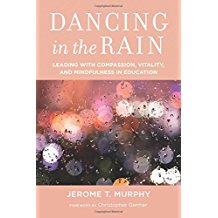
Keep Calm and Dance

Jerome Murphy of Harvard’s Graduate School of Education has made a career of educational leadership, and has first-hand experience of the stress, burnout, and even despair that can come with a lifetime of trying to satisfy the needs and demands of faculty, staff, students, and a host of other stakeholders. “Honking and hissing like geese,” goes Murphy’s goose theory of leadership, “faculty and staff members will cruise into the boss’s office, ruffle their feathers, poop on the rug, and leave” (p. 44), expecting a solution to whatever problem they brought in. The unskillful response of many leaders under these conditions is to obsessively ruminate, resist the discomfort and try to escape it, and rebuke themselves for not measuring up. The more they try to escape their discomfort, the more entangled they become in it. Can anyone relate yet?

Murphy’s answer in Dancing in the Rain: Leading with Compassion, Vitality, and Mindfulness in Education, is learn to live with the emotional discomfort and get it to work for you. When it rains, don’t run for cover; learn to dance in it. His formula for doing this, developed over a career, is summed up by the acronym MYDANCE:

Mind your values: Take action inspired by what matters most to you
Yield to now: Slow down and focus on the present moment
Disentangle from upsets: Mentally step back, observing and making room for upsets
Allow unease: Open up to upsets even if you dislike them
Nourish yourself: Engage in activities that replenish your energy and restore your perspective
Cherish self-compassion: Give yourself the kindness you need and deserve
Express feelings wisely: Carefully reveal your human side so that you can build trusting relationships (p. 41)

Murphy takes the reader through these Buddhist-inspired precepts chapter by chapter, and includes many easy-to-do exercises. For example in the Mind Your Values chapter, we are invited to call to mind a favorite leader, reflecting on the person’s values and how the person makes us feel. In Yield to Now, a 5-minute exercise suggests focusing in turn on the five senses, bringing attention back gently each time the mind wanders.

This definitely isn’t your typical educational leadership book. It’s more of a handbook on surviving and thriving amid the slings and arrows of academic administration. If your professional life seems to be a constant struggle, this may be the therapy you need.

(This review was also posted on Amazon)